
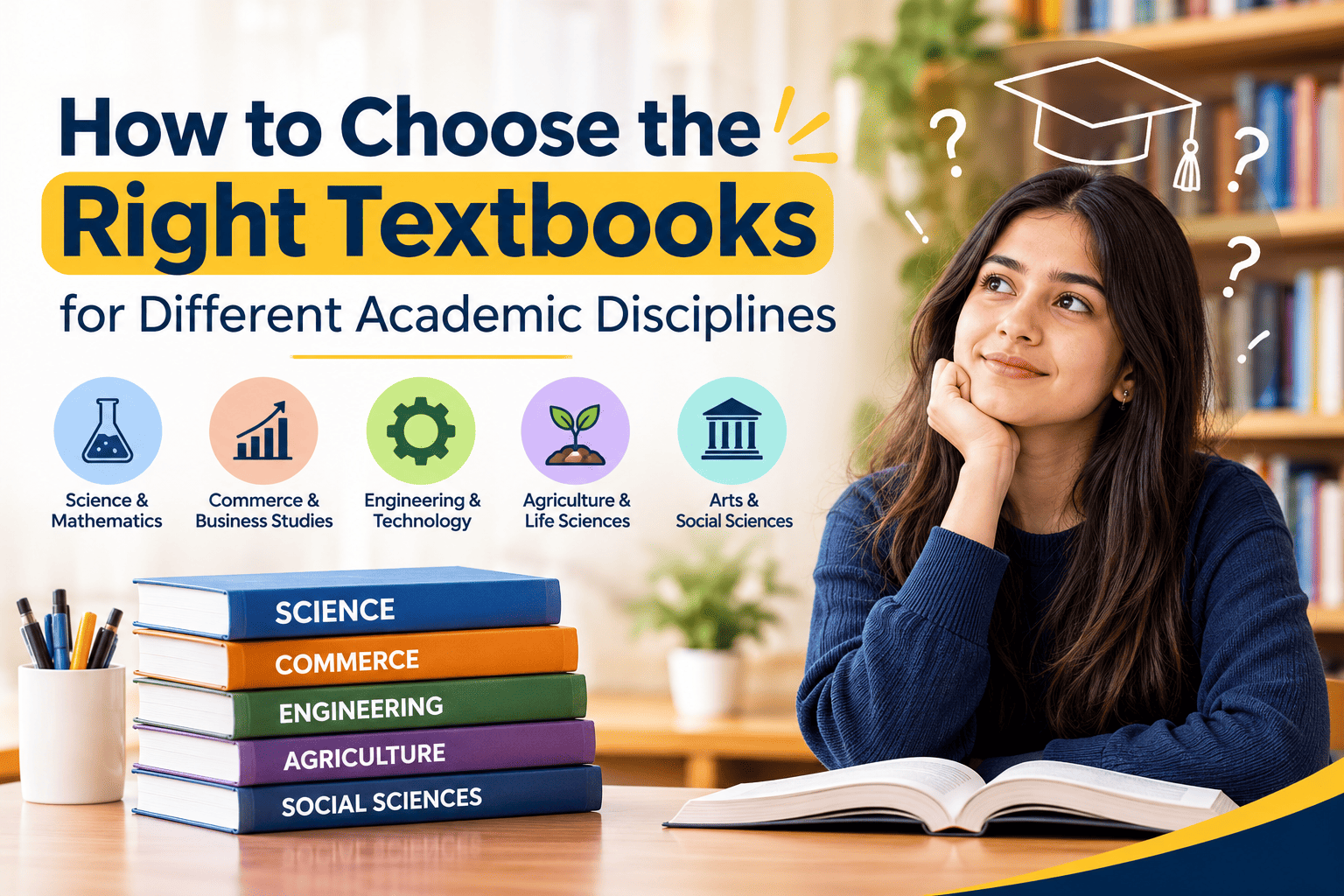
Choosing the right textbook is an important part of preparing for an academic course. Every subject has its own concepts, learning requirements, and areas of specialization. A book that works well for a science student may not meet the needs of someone studying commerce, engineering, or agriculture. Therefore, students should consider their academic discipline, course syllabus, and learning objectives before selecting their study material.
With numerous academic books available, identifying the most suitable ones can sometimes be challenging. Understanding what to look for in textbooks across different disciplines can help students make informed purchasing decisions and build a useful collection of learning resources.
Understanding Your Academic Requirements Before Choosing a Textbook
The first step in selecting a textbook is understanding what your course requires. Different schools, colleges, and universities follow specific curricula, and the recommended study material may vary depending on the programme.
Before purchasing a book, review your syllabus and identify the subjects and topics you need to study. Consider whether you require an introductory textbook, an advanced subject publication, or a practical learning resource.
It is also important to consider your current academic level. Beginners may benefit from books that explain fundamental concepts in a straightforward manner, while advanced students may need more detailed discussions, technical examples, and subject-specific information.
Once you understand these requirements, you can narrow down your choices and focus on books that are relevant to your studies.
Choosing Textbooks for Different Academic Disciplines
Every discipline requires a different approach to learning. Understanding these differences can help students select books that match their course content and academic goals.
1. Science and Mathematics
Science and mathematics involve concepts that often require logical reasoning, calculations, and practical understanding. Students studying these subjects should look for textbooks that explain theories clearly and include relevant examples, equations, diagrams, and exercises.
For example, physics textbooks should explain scientific principles alongside their mathematical applications. Chemistry books should cover important concepts, chemical processes, and relevant practical information. Mathematics textbooks should provide progressive explanations and sufficient practice problems.
Students should also consider whether the book covers the topics included in their prescribed syllabus.
2. Commerce and Business Studies
Commerce students study subjects related to accounting, finance, economics, business administration, and management. These disciplines require an understanding of concepts as well as their application in business situations.
When selecting commerce textbooks, students should look for clear explanations of financial principles, accounting methods, economic concepts, and business practices. Relevant examples and practical exercises can make complicated topics easier to understand.
Books should also match the student’s academic level, particularly when moving from introductory commerce subjects to specialized areas of study.
3. Engineering and Technology
Engineering education involves technical knowledge, calculations, scientific principles, and practical applications. Students often need textbooks that combine theoretical explanations with technical illustrations, numerical examples, and problem-solving exercises.
For instance, electrical and electronics engineering students may require books covering electrical systems, electronic components, circuit concepts, and related engineering principles.
A publication such as A Course in Electrical and Electronics Engineering can be relevant to students exploring this discipline. The choice of book should ultimately depend on the specific subjects and topics included in their course.
4. Agriculture and Life Sciences
Agriculture and life sciences cover a broad range of subjects, including crop production, soil science, plant biology, food science, and agricultural practices.
Students in these disciplines may need textbooks that explain biological processes, agricultural methods, scientific principles, and their practical applications.
For example, a book such as A Manual of Food Chemistry & Microbiology may be relevant to learners exploring food-related scientific subjects. Similarly, students interested in agricultural studies can explore publications such as A Competitive Book of Agriculture.
The most suitable choice depends on whether the student is studying basic agricultural concepts, specialized topics, or competitive examination material.
5. Arts and Social Sciences
Arts and social science disciplines include subjects such as history, geography, sociology, political science, psychology, and literature. These subjects often require students to understand theories, historical developments, social structures, and different interpretations of events.
When selecting textbooks, students should consider the subject coverage, clarity of explanations, relevant examples, and alignment with their academic curriculum.
Books that present information in a well-organized manner can help students understand different perspectives and prepare for discussions, assignments, and examinations.
What Should You Check Before Purchasing a Textbook?
Apart from subject relevance, a few additional factors can help you evaluate whether a textbook is suitable for your needs.
- Syllabus coverage: Check whether the book includes the topics prescribed in your course.
- Content organization: Look for logically arranged chapters and clear explanations.
- Examples and exercises: Practical questions, illustrations, and examples can support better understanding.
- Author credentials: Consider the author’s academic qualifications and subject knowledge.
- Publication and edition: Review the publication details and ensure that the edition is appropriate for your course requirements.
- Academic level: Choose a book that matches your current understanding and learning objectives.
Taking time to review these details can help you avoid purchasing books that do not adequately support your studies.
Explore Subject-Wise Textbooks at Himanshu Publications
Finding textbooks across different academic disciplines becomes easier when you have access to a platform offering a broad selection of educational publications.
Established in 1983, Himanshu Publications provides an online platform where students, educators, and readers can explore books across various subjects. Its textbook collection includes categories such as accounting, agriculture, botany, chemistry, computer science, economics, education, engineering, geography, history, mathematics, physics, sociology, and zoology.
Whether you are looking for a science textbook, a publication related to engineering, or learning material for commerce and social sciences, you can browse the available titles according to your academic interests.
Visit the Text Books collection at Himanshu Publications to explore available publications and find suitable books for your course or subject requirements.
Conclusion
Selecting the right textbooks requires an understanding of your academic discipline, course syllabus, and learning objectives. Different subjects require different types of explanations, examples, and practical learning resources. Therefore, students should evaluate books based on their content, relevance, academic level, and publication details before making a purchase.
A carefully selected collection of textbooks can support regular studies, improve subject understanding, and help students prepare for their academic responsibilities. Explore the textbook collection at Himanshu Publications to discover publications across different disciplines and choose learning resources that match your educational needs.